eCall Even more relevant today
Back in 2022, I wrote about eCall and questioned whether New Zealand should begin planning for its introduction.
Four years later, I think the question is even more relevant.
Since March 2018, all new passenger vehicle and light commercial vehicle models approved for sale in the European Union have been required to support eCall. With eCall, when there is a serious crash, the vehicle can automatically contact emergency services, establish a voice connection, and transmit critical information including location, direction of travel, vehicle identification, and other incident-related data.
The objective is simple: get help to people faster when every minute matters.
European Commission estimates suggest eCall can reduce emergency response times by up to 40% in urban areas and 50% in rural areas. It is also estimated to reduce fatalities by at least 4% and severe injuries by 6%.
Europe is no longer debating whether to implement eCall. It is now transitioning the service to Next Generation eCall over 4G and 5G networks.
Yet neither Australia nor New Zealand has adopted a nationally coordinated eCall capability comparable to Europe.
In many cases, vehicles already contain much of the required technology. The challenge is less about the vehicle itself and more about the supporting emergency communications ecosystem.
That challenge is becoming increasingly relevant in New Zealand. Recent discussion around modernising the 111 service has highlighted the importance of governance, interoperability, operating models and investment across the entire emergency communications ecosystem. Those are many of the same foundations that would be required to successfully implement eCall. (Otago Daily Times Online News)
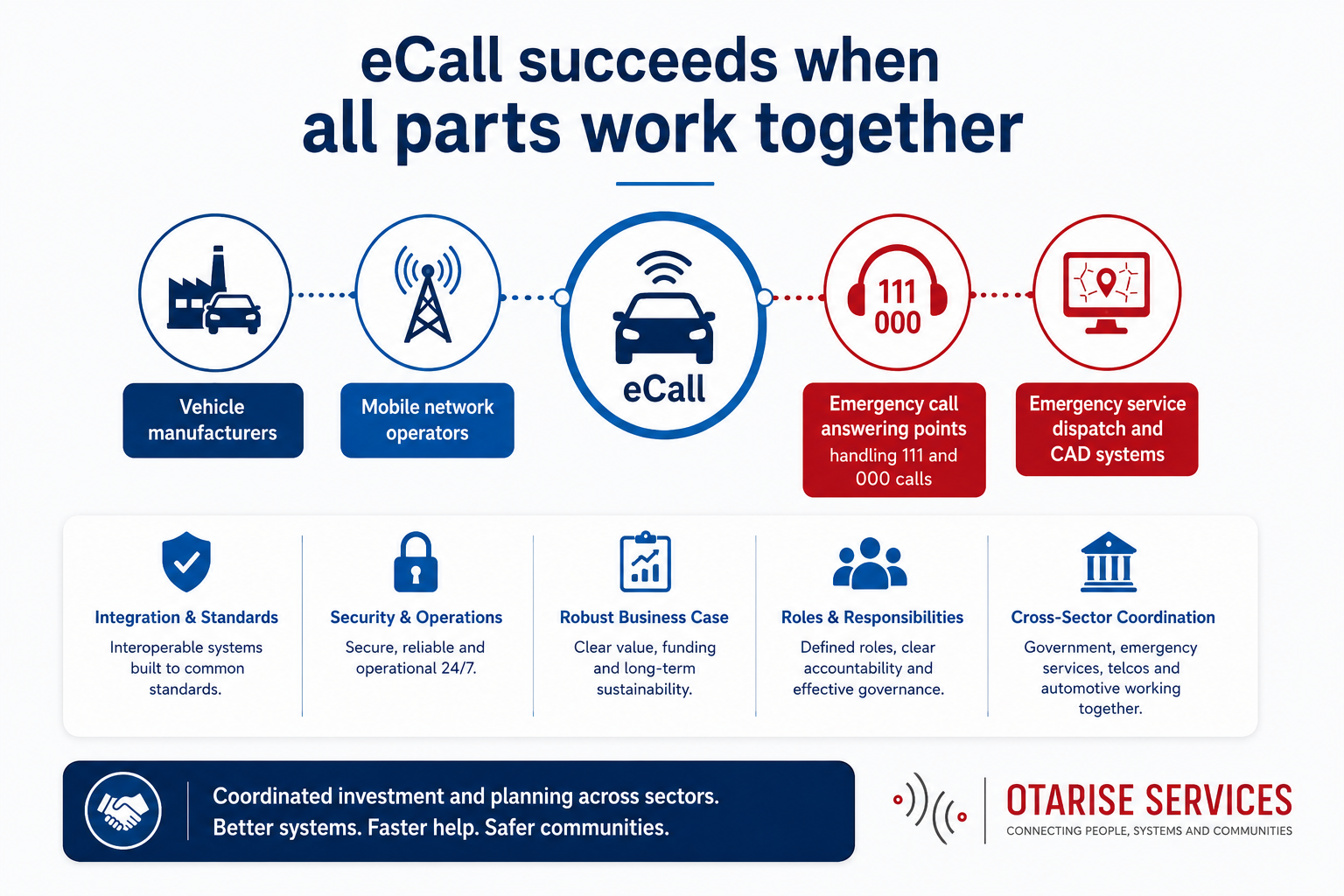
Implementing eCall requires coordinated investment and planning across multiple sectors:
• Vehicle manufacturers
• Mobile network operators
• Emergency call answering points handling 111 and 000 calls
• Emergency service dispatch and CAD systems
Significant integration, standards, security, and operational work would still be required. There would also need to be a robust business case and a clear understanding of roles, responsibilities, funding, and governance. Successfully implementing eCall would require coordination across government, emergency services, telecommunications providers, and the automotive industry.
As Australia and New Zealand continue investing in public safety technology, connected vehicles, emergency communications, and next-generation mobile networks, it feels increasingly relevant to ask a simple question.
Why are we still relying almost entirely on a bystander making a call to 111 or 000 after a serious crash when the vehicle itself could already be calling for help?
https://www.linkedin.com/feed/update/urn:li:activity:7477494553848225792/