International Roaming for Public Safety
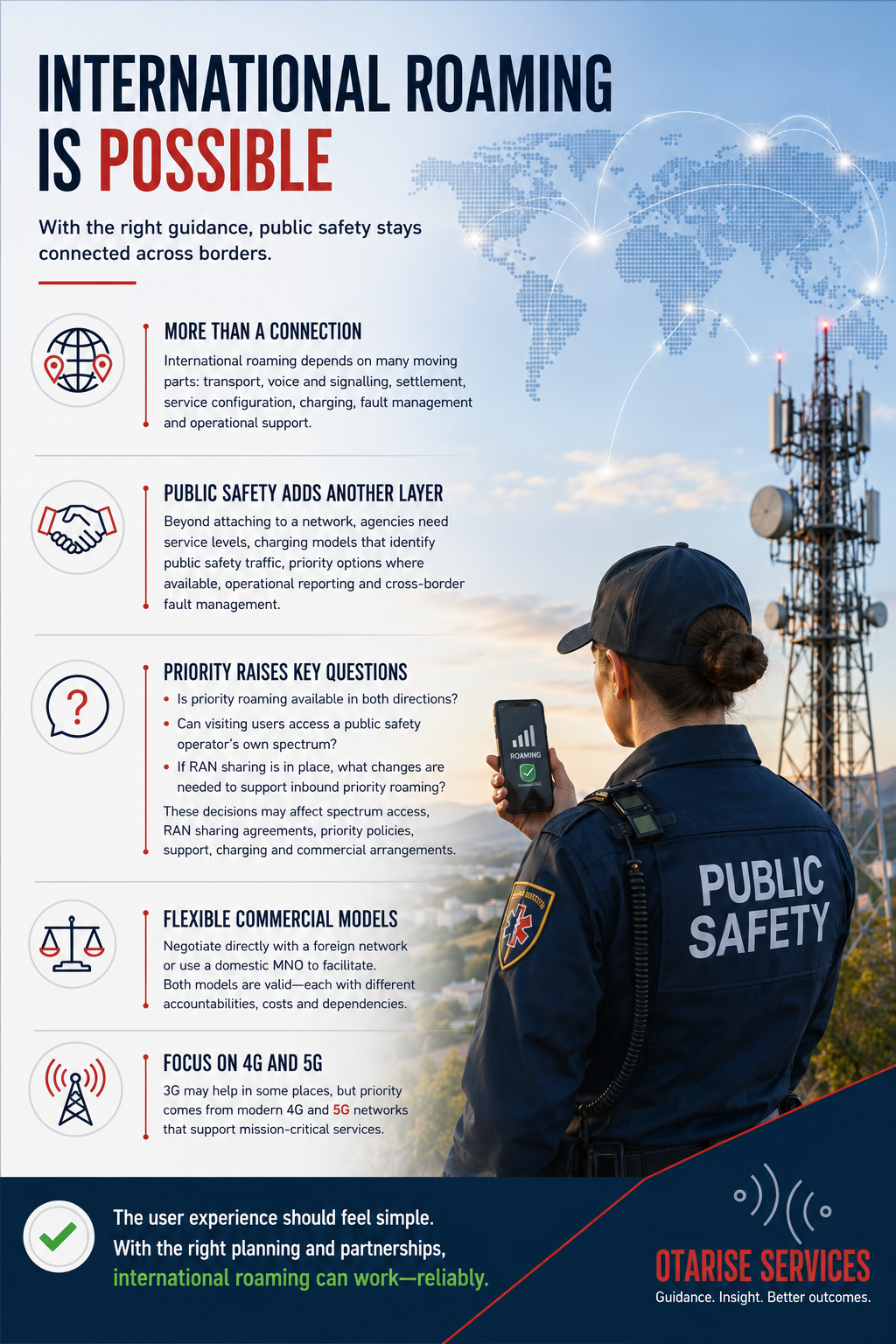
International roaming feels simple for consumers, but making it work for public safety users means solving a much harder problem across networks, agreements, support models, charging, reporting, and accountability.
That issue is now becoming more visible as Europe prepares the European Critical Communication System and the industry works through mission-critical roaming, cross-border MCX, and operational mobility.
Before international roaming works, operators need more than a network connection.
They need arrangements for data transport, voice and signalling, financial settlement, service configuration, charging, fault management, and operational support. These are usually handled through roaming agreements and the supporting providers that sit behind them.
Public safety adds another layer.
It is not just a question of whether a device can attach to a visited network. Public safety agencies also need to think about support service levels, charging models that can identify public safety traffic, operational reporting, priority arrangements where available, and how faults are managed across international boundaries.
Priority also raises some specific questions.
Is priority roaming available in both directions, or only for outbound users from one country?
If a public safety operator has its own spectrum, can visiting public safety users access that spectrum, or are they limited to commercial mobile spectrum?
If the public safety operator already uses a RAN sharing arrangement with one or more mobile network operators, what changes would be needed to support inbound priority roaming? Would existing spectrum access, priority policies, operational procedures, reporting, and charging arrangements need to change?
These questions matter because public safety roaming is not only about the roaming agreement between two operators. It may also affect domestic spectrum access, RAN sharing agreements, priority policies, operational support, charging models, and the commercial arrangements between the public safety operator and its mobile network partners.
There is also a commercial model question.
A public safety entity may choose to negotiate and connect directly with a foreign network. Alternatively, it may use a domestic mobile network operator to facilitate the roaming connectivity, technical arrangements, and commercial agreements.
Both models may be valid. Both create different accountabilities, costs, and operational dependencies.
Legacy mobile networks may still matter for coverage in some countries, but they will not provide the priority and mission-critical treatment that public safety users may expect. The more important question is how public safety roaming should work across modern 4G and 5G networks to support services including mission-critical applications.
The user experience should feel simple.
The work required to make that happen is anything but simple.
https://www.linkedin.com/feed/update/urn:li:activity:7474941340280135680/