Device Ecosystem
In February 2021, I wrote a short paper on the cellular device and ecosystem challenges for public safety broadband.
At the time, much of the discussion focused on the device itself.
What phone should frontline staff use? Should it be ruggedised? Should it support MCPTT? Which accessories are compatible?
They are important questions, but they are only part of the picture.
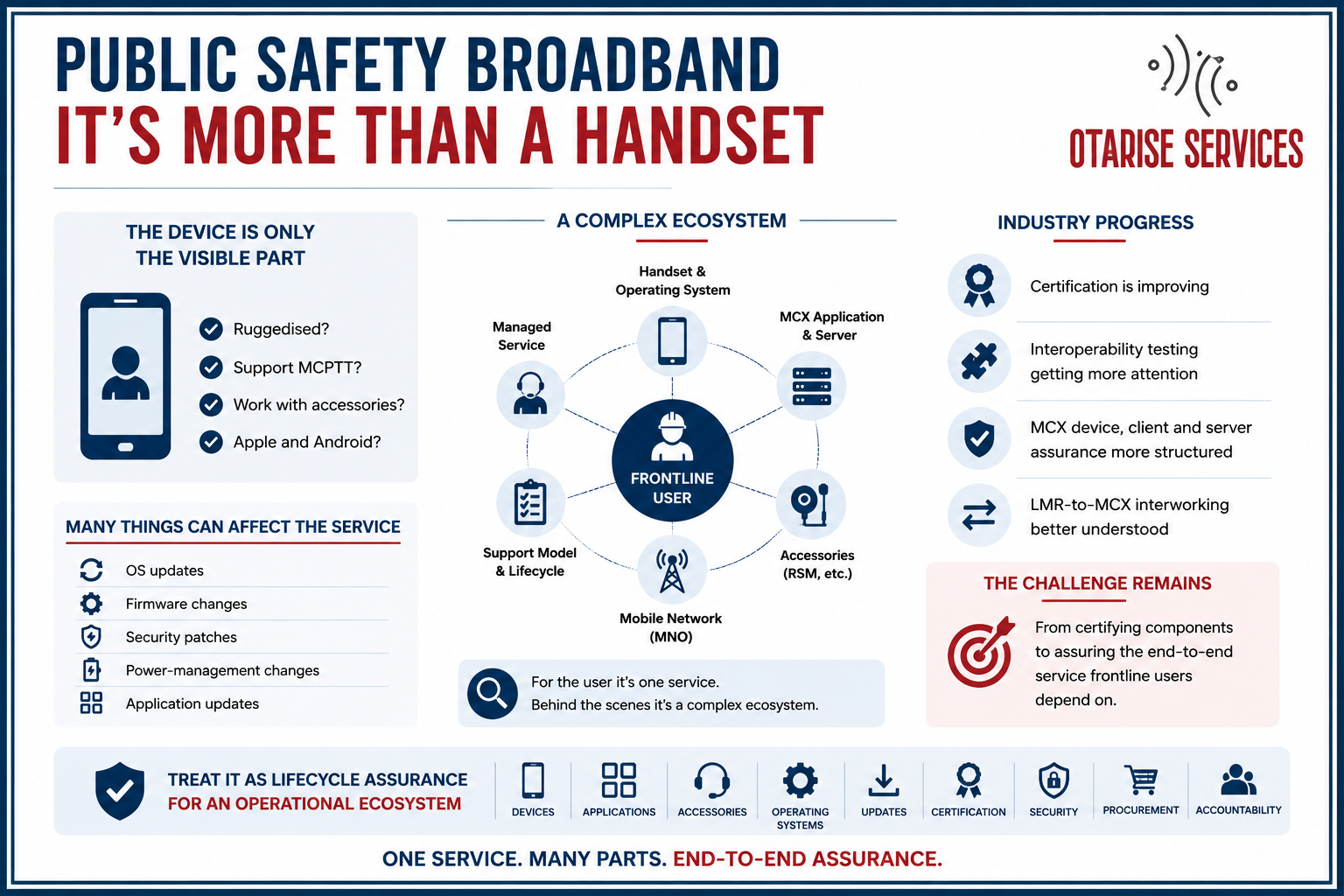
Unlike traditional land mobile radio, where the radio, software, accessories and support model are delivered as a tightly integrated solution, a cellular public safety service spans multiple suppliers.
The handset may come from one vendor, the operating system from another, the MCX application from a third, accessories from a fourth, the mobile network from an operator, and the managed service from yet another provider.
For the frontline user it is still one communications service, but behind the scenes it is a complex ecosystem. Operating system updates, security patches, firmware changes and application upgrades can all affect how that service performs.
The industry has made good progress.
Certification is improving. Interoperability testing is getting more attention. MCX device, client and server assurance is becoming more structured. LMR to MCX interworking is better understood.
The remaining challenge is to shift from certifying individual components to assuring the end-to-end service.
It needs to be treated as lifecycle assurance for an operational ecosystem.
That means thinking about devices, applications, accessories, operating systems, updates, certification, support, security, procurement and accountability as one connected problem.
The handset is only the visible part of the system.