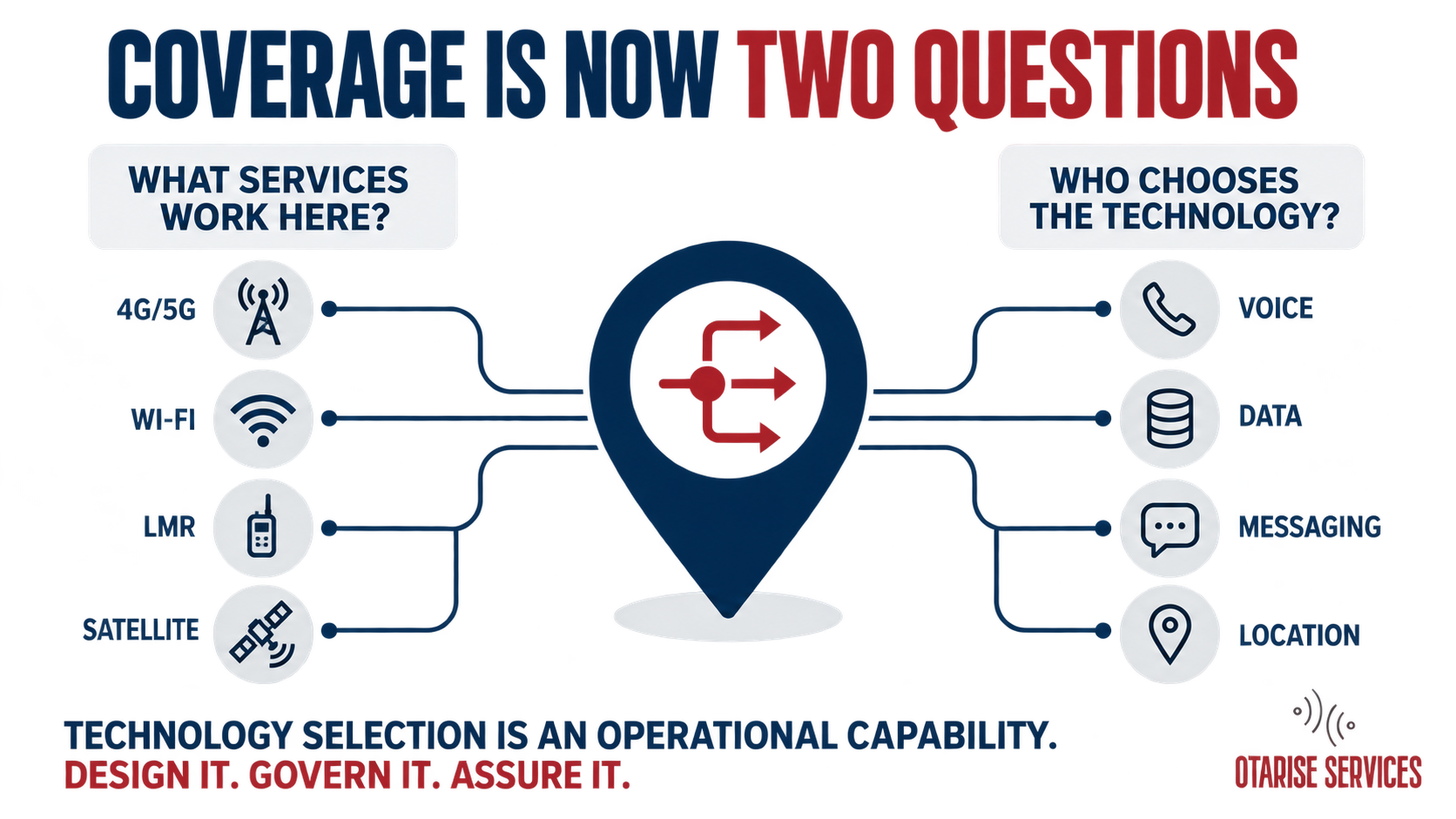
Coverage has two questions
“Is there coverage?” is becoming two different questions.
For decades, coverage has largely been presented as a static geographic answer: a location is covered, partially covered or not covered.
That is no longer enough.
The first question is:
What services are actually available to this user and device at this location, right now?
Several technologies may be available:
4G or 5G
Wi-Fi
LMR
Direct-to-device satellite
But each may support a different set of services. These could include voice calling, emergency calling, corporate data, internet access, SMS or internet messaging, MCPTT, priority or quality-of-service treatment, and real-time location information.
Seeing a 4G, 5G or Wi-Fi signal does not tell the user which services are available, authorised or performing well enough for the operational task.
Service availability may also change with network congestion, device capability, subscription, user identity, agency policy and the operational situation.
The second question is:
Who decides which technology should be used at that location?
Is the choice made by:
The user?
The device manufacturer or operating-system provider?
The mobile network operator?
The application?
The organisation’s IT or communications team?
An automated decision tool applying agreed operational rules?
In many situations, the technical choice needs to be seamless. But the rules behind it involve operational policy, accountability and risk.
A static two-dimensional map may indicate potential signal availability. It cannot describe the current availability of every service or govern how the appropriate technology is selected.
Coverage presentation needs to evolve from static network maps to dynamic, service-based information. That information then needs to become part of operational processes so users, devices, applications and control rooms can make appropriate decisions as conditions change.
The better question is:
“What can I do here, and who decides how it should be delivered?”
Answering that question will require increasingly event-driven, automated and dynamic decision-making, which I have deliberately avoided calling AI.
We should not ignore the complexity of technology selection simply because it happens automatically or is hidden from the user.
Selection rules need to be deliberately designed, operationally governed and tested under real conditions. Otherwise, critical decisions may be left to device settings, vendor defaults or network behaviour that does not reflect the operational need.
Technology selection should be treated as an operational capability, with defined requirements, accountable ownership and assurance.
Who owns that decision in your organisation, and who is already making the choices for you?
#CriticalCommunications #PublicSafety #Coverage #MissionCritical #Telecommunications