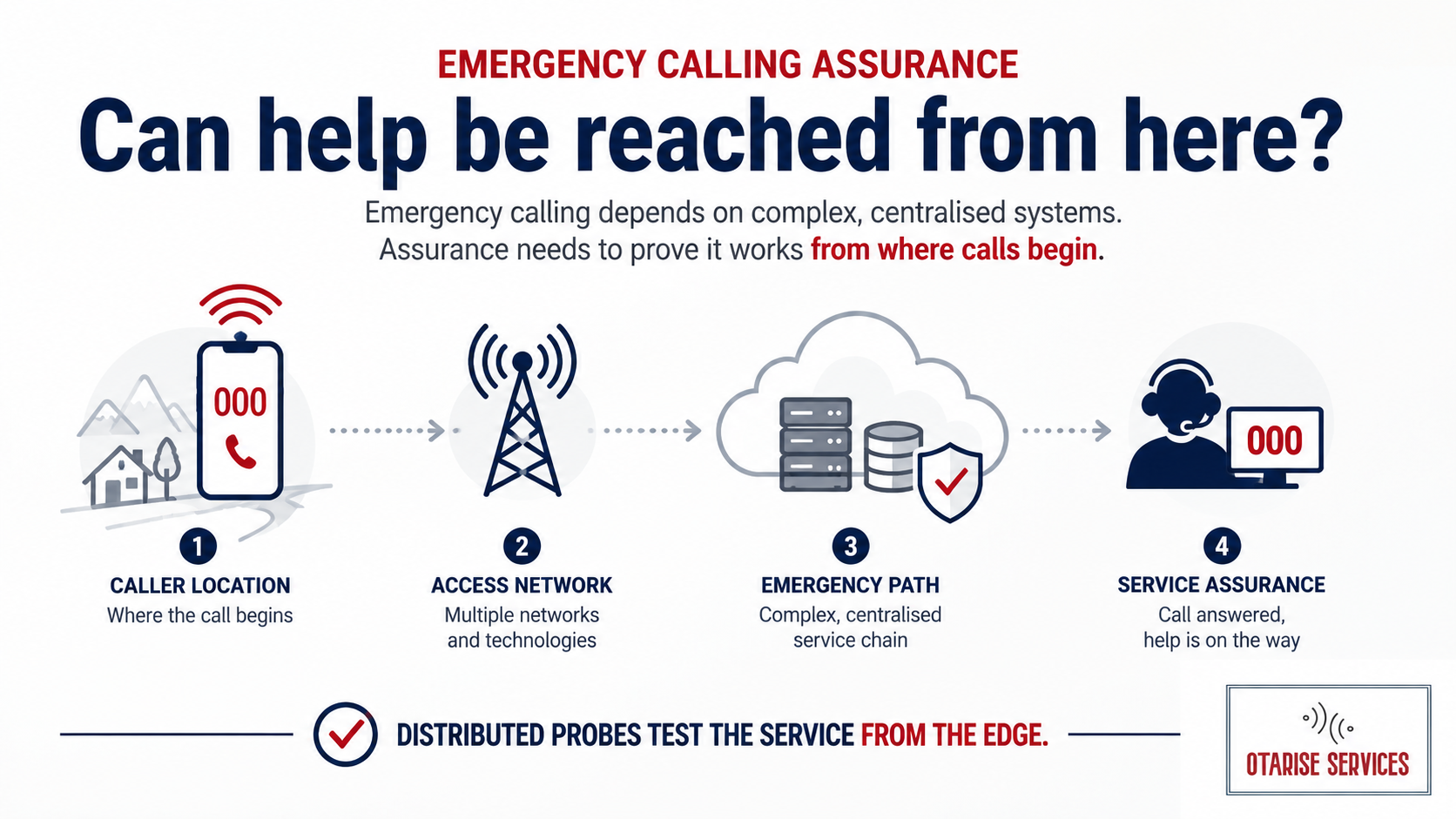
Emergency Calling Assurance Probes
Distributed test probes are one practical way to identify problems with emergency calling.
They can help answer a basic assurance question: can a person at a specific location, using a specific network and technology, reach help right now?
In my previous post, I wrote about how emergency calling has become more dependent on centralised platforms, national routing, shared infrastructure and software-based service logic. The issue is not that centralised architectures are inherently weak. They can be highly resilient. The issue is that the failure domain has changed.
Traditional assurance often focuses on whether platforms are available, redundant systems are in service, alarms are clear, and operational processes are working. Those questions remain important, but they do not always prove that emergency calling works end to end from the caller’s location.
That is where distributed probes may help.
The concept is to place controlled test points across selected locations, networks, technologies and emergency call routes, then use them to make safe test calls through the emergency calling system. This would not replace provider testing, platform monitoring, regulatory reporting or operational assurance. Those remain essential.
But emergency calling is experienced by the public as one essential service, not as a collection of provider-managed systems. That means assurance needs to work at the service level.
I have put together a short white paper on this idea: distributed assurance for centralised telecommunications architectures.