Telecommunications Architectures Have Changed
There has been a lot of discussion, commentary and analysis recently about telecommunications failures affecting emergency calls.
Much of it asks whether the telecommunications industry has failed in its responsibility to protect emergency calling.
That is a fair question.
But it is also worth looking at how telecommunications architecture has changed over the past 30 to 40 years, because the nature of failure has changed with it.
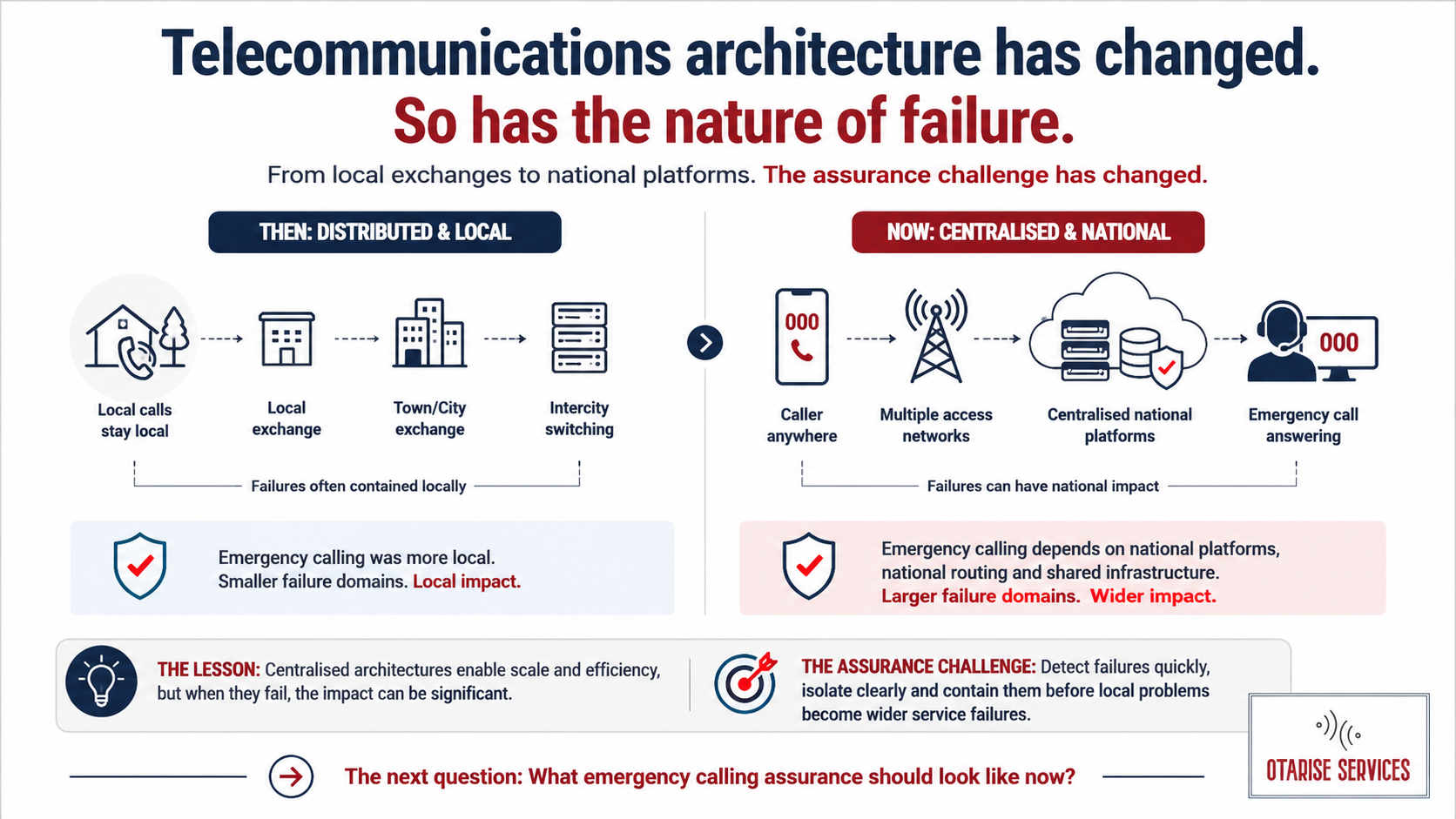
In the earlier fixed telephony era, networks were highly distributed. Local exchanges served defined areas and handled local calls. Those exchanges connected to town or city exchanges, often through diverse routes. Calls outside the area were handed to intercity switching systems.
Emergency calling was more local in nature.
Today, voice services are largely managed through national IP and data infrastructure, with a smaller number of large platforms handling call control, routing, authentication, policy and service logic.
This evolution made sense. Modern compute, optical transmission, packet networks and software platforms allow much greater scale, efficiency and flexibility.
But the trade-off is a different kind of resilience challenge.
Modern platforms can be highly resilient by design. They are often geo-redundant and connected by diverse transmission paths. But the overall system is also more concentrated, software-dependent and operationally complex.
Emergency calling now depends on national platforms, national routing, shared data infrastructure and centralised operational processes.
When something fails, the failure domain can be much larger.
The lesson is not simply that the telecommunications industry is failing in its responsibility. It is that the long-term drive for scale, efficiency, internet-based services and lower unit cost has created more centralised architectures.
Those architectures can be highly resilient. But when they fail, the impact can be significant.
In a centralised architecture, the assurance challenge is making sure failures are detected quickly, isolated clearly and contained before local problems become wider service failures.
The next question is what emergency calling assurance should look like now.