Resilience and Service Degradation
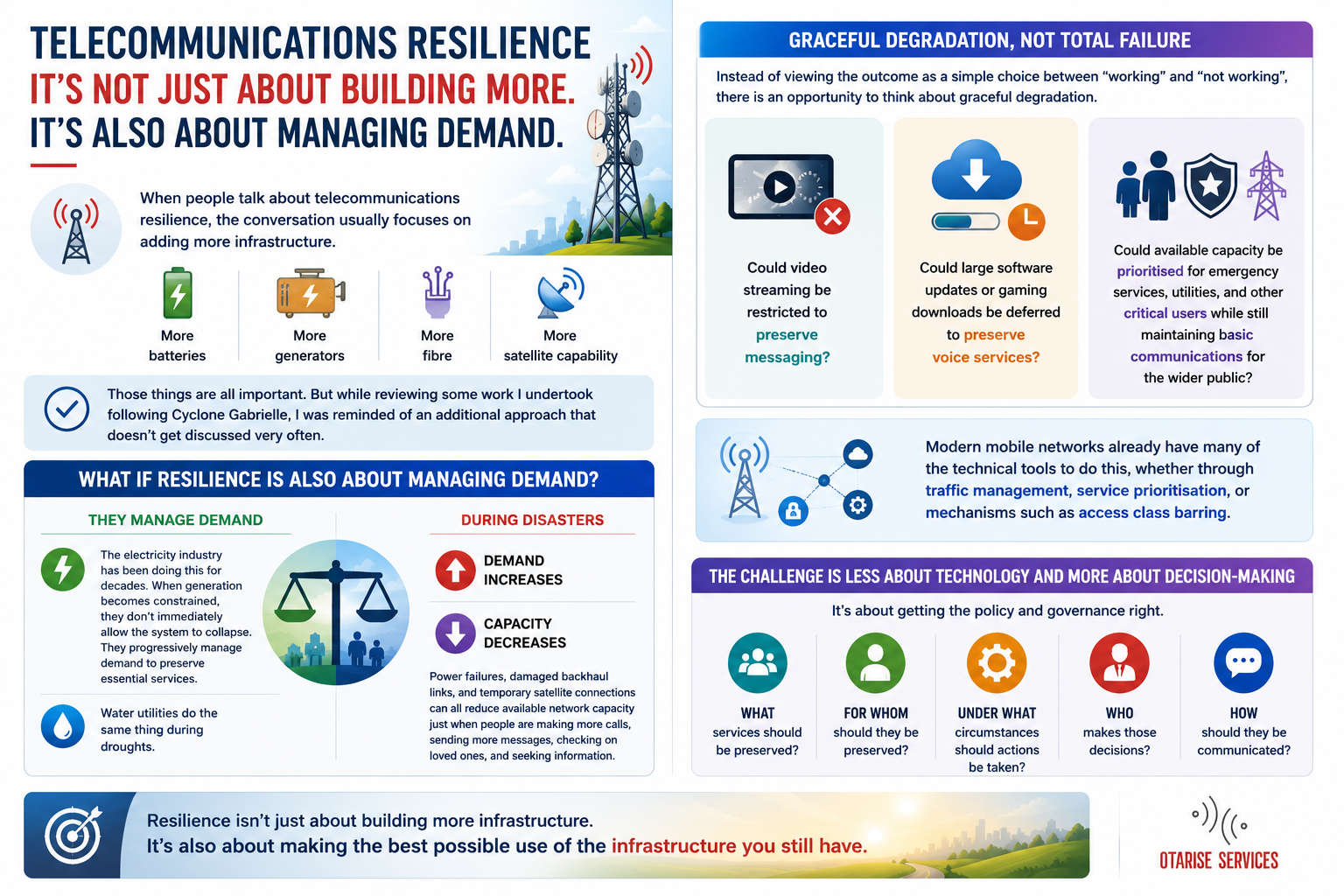
When people talk about telecommunications resilience, the discussion usually focuses on adding more infrastructure. More batteries. More generators. More fibre. More satellite capability.
Those things are all important. But while reviewing some work I undertook following Cyclone Gabrielle, I was reminded of an additional approach that doesn’t get discussed very often.
One of the recommendations from that work was to consider how demand management techniques could be used when network resources become constrained.
The electricity industry has been doing this for decades. When generation becomes constrained, they don’t immediately allow the system to collapse. They progressively manage demand to preserve essential services. Water utilities do the same thing during droughts.
During a disaster, demand often increases at exactly the same time that network capacity decreases. Power failures, damaged backhaul links, and temporary satellite connections can all reduce available network capacity just when people are making more calls, sending more messages, checking on loved ones, and seeking information.
Instead of viewing the outcome as a simple choice between “working” and “not working”, there is an opportunity to think about graceful degradation. Rather than losing service entirely, limited network resources could be managed to maximise the number of users and continuity of critical services.
Should video streaming be restricted to preserve messaging?
Should large software updates or gaming downloads be deferred to preserve voice services?
Should available capacity be prioritised for emergency services, utilities, and other critical users while still maintaining basic communications for the wider public
Modern mobile networks already have many of the technical tools to do this, whether through traffic management, service prioritisation, or mechanisms such as access class prioritisation.
The challenge is less about technology and more about deciding what services should be preserved, for whom, under what circumstances, who makes those decisions, and how they should be communicated.
Resilience isn’t just about building more infrastructure. It’s also about making the best possible use of the infrastructure you still have.
https://www.linkedin.com/feed/update/urn:li:activity:7469874654527029249/