AI and Public Safety
I think the AI industry is confusing its own customers when it lumps everything under a single term: "AI".
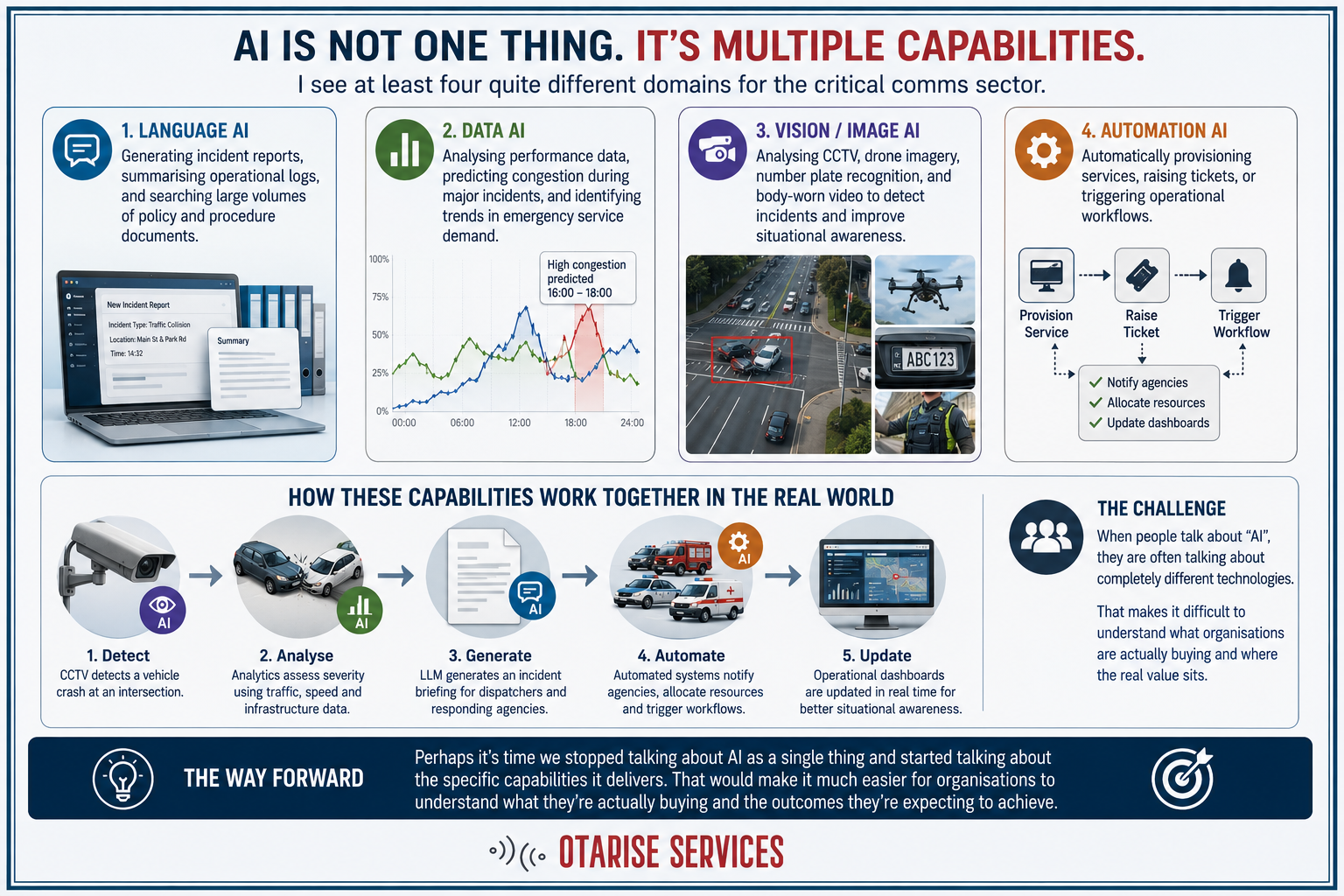
In reality, I see at least four quite different domains for the critical comms sector:
Language AI – generating incident reports, summarising operational logs, and searching large volumes of policy and procedure documents.
Data AI – analysing performance data, predicting congestion during major incidents, and identifying trends in emergency service demand.
Vision/Image AI – analysing CCTV, drone imagery, number plate recognition, and body-worn video to detect incidents and improve situational awareness.
Automation AI – automatically provisioning services, raising tickets, or triggering operational workflows.
Most real-world public safety solutions will eventually combine several of these capabilities.
For example, a CCTV camera could detect a vehicle crash at an intersection. Analytics could assess the likely severity based on traffic conditions, vehicle speeds, and nearby infrastructure, estimating the potential impact on people and property. An LLM could then generate an incident briefing for dispatchers and responding agencies. Automated systems could notify police, fire, ambulance, and transport authorities while allocating resources and updating operational dashboards.
The challenge is that when people talk about "AI", they are often talking about completely different technologies. That makes it difficult to understand what organisations are actually buying and where the real value sits.
Perhaps it’s time we stopped talking about AI as a single thing and started talking about the specific capabilities it delivers. That would make it much easier for organisations to understand what they’re actually buying and the outcomes they’re expecting to achieve.
https://www.linkedin.com/feed/update/urn:li:activity:7467382164486258688/