5G Edge Computing for Public Safety
One of the 5G features most frequently promoted by vendors, mobile network operators and industry commentators is edge computing.
I understand the attraction.
Move processing closer to the user, reduce latency and improve application performance. It sounds like a natural fit for public safety.
But the more I think about it, the less convinced I am that public-safety edge computing will develop in quite the way the industry sometimes suggests.
I struggle with the idea that an agency would place sensitive operational applications and data throughout an MNO’s infrastructure simply to gain a potentially modest improvement in processing or transport latency.
There is also another issue that I think receives far less attention: the application itself may need to be redesigned.
Most public-safety applications assume a stable central platform and an authoritative database. If processing is distributed across hundreds or thousands of cell sites, someone must decide which functions run locally, what data each instance holds and how the different instances remain synchronised.
What happens when a responder moves between sites? Does the application session move with them? What happens to transactions completed while an edge location is isolated? How are those transactions reconciled when connectivity is restored?
Software updates, security patches and configuration changes would also need to be deployed consistently across every location.
This is not simply hosting the same application closer to the user.
It is redesigning the application—and its operating model—as a distributed system.
Then there are the security and governance questions.
Who controls the platform? Who can access the application, data and logs? Where are the encryption keys held? Which system contains the authoritative record? And how does the agency maintain consistent security, auditability and software integrity across multiple edge locations?
None of these problems is impossible to solve.
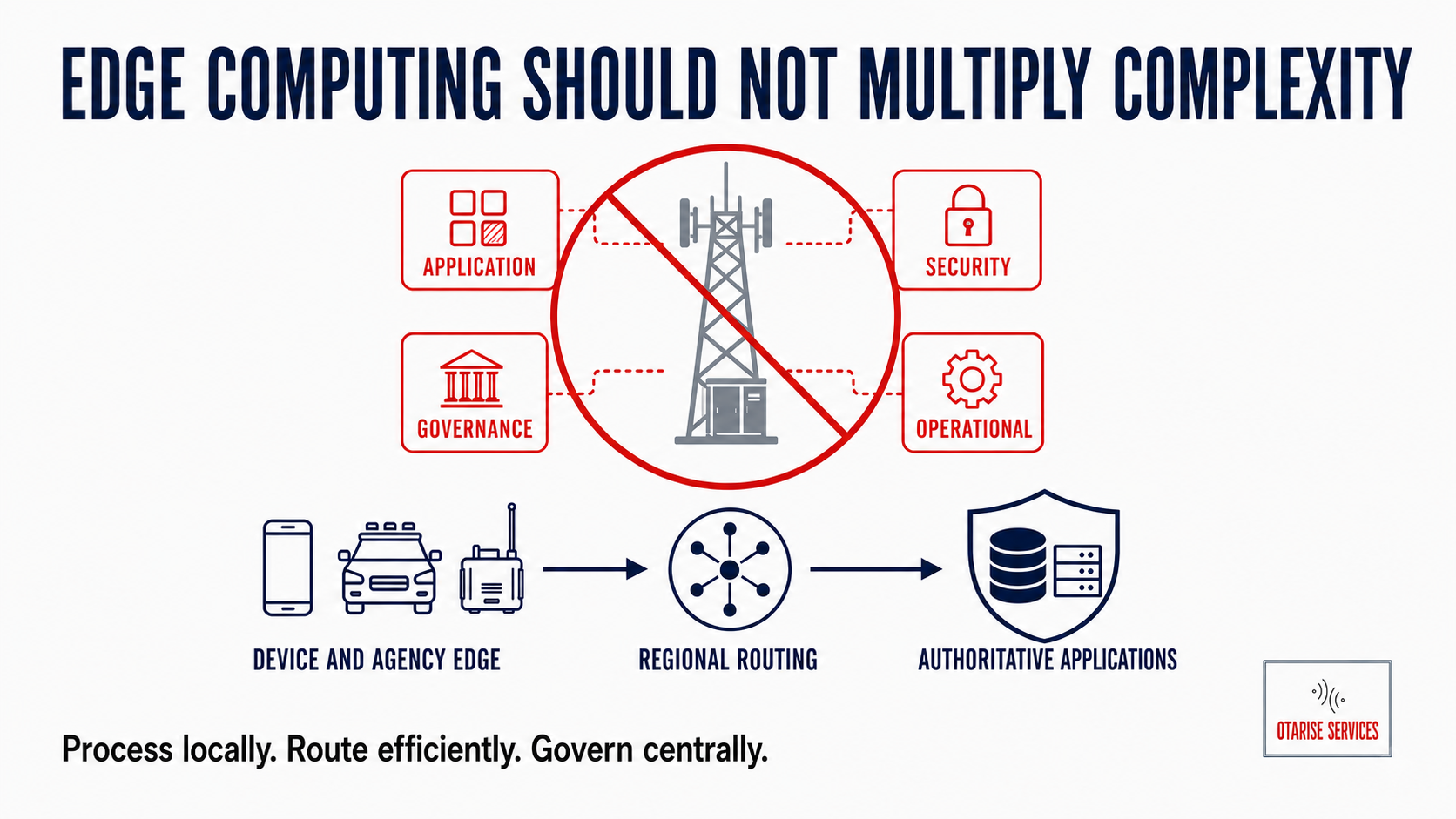
But solving them adds another layer of application, security, governance and operational complexity.
For authoritative applications such as CAD, evidence management, identity, intelligence and incident records, centralised governance may still matter far more than shaving a few milliseconds from the data path.
That does not mean edge computing has no place in public safety.
Processing on a responder’s device, in a vehicle or within an agency-controlled deployable system could be extremely valuable. It could reduce the amount of video or sensor data transmitted, support operations when connectivity is impaired and allow sensitive information to remain under agency control.
The MNO can still add value by improving performance through efficient regional routing, while the applications and data remain within an environment controlled by the agency.
So I suspect the strongest architecture may be a combination of device and agency-controlled edge processing, efficient regional routing, and centrally governed authoritative applications.
The technology is real, and there will be use cases where it delivers genuine operational value.
But for public safety, the important question is not simply how close an application can be placed to the network edge.
It is how close processing needs to be to the operational problem—while the agency retains control of what matters.