Mobile Voice Vulnerabilities
Most people think the resilience of a mobile phone call is determined by the nearest cell tower.
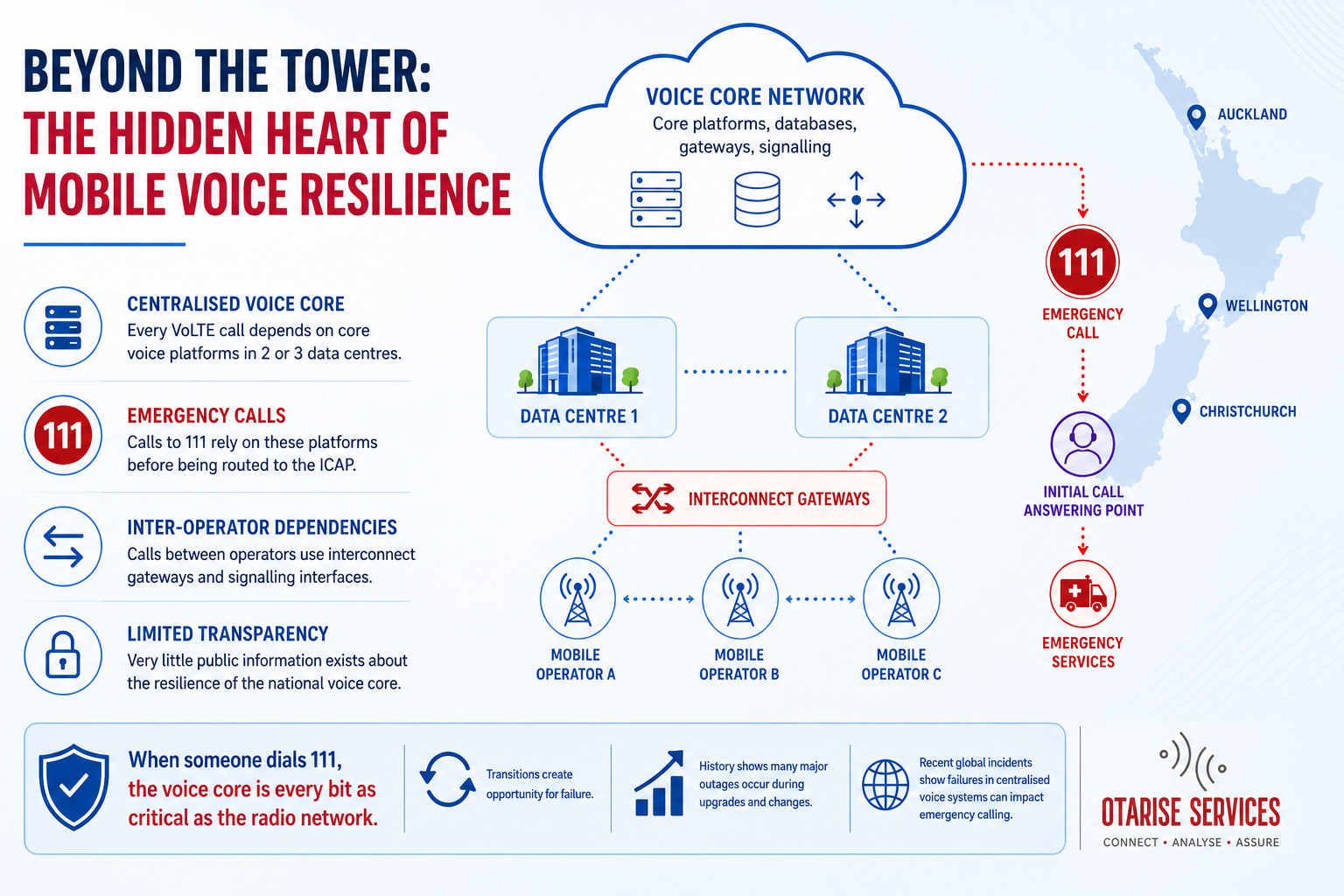
In reality, today’s voice services depend on a complex national network of core platforms, databases, gateways, signalling systems, routing rules, and data centres.
I sometimes wonder whether we spend enough time discussing the resilience of the voice core itself.
Historically, telecommunications networks were built around large numbers of geographically distributed switching facilities. Today, mobile voice is delivered as an IP application running on much more centralised infrastructure.
A few observations:
Every VoLTE call depends on core voice platforms located in a small number of national data centres.
Emergency calls to 111/000 also depend on these platforms before being routed to the Initial Call Answering Point.
Calls between mobile operators rely on interconnect gateways and signalling interfaces between networks.
Mobile operators publish a reasonable amount of information about radio network resilience, but there is much less public information available about the resilience architecture of the national mobile voice ecosystem itself.
The networks are highly resilient. They have demonstrated that over many years.
From the outside, however, it is difficult to understand how much redundancy exists across the full voice path, how voice traffic is rerouted during major failures, and what single points of failure may still remain.
This becomes particularly relevant as the industry prepares for Voice over New Radio, or VoNR, which will enable voice services to operate directly over standalone 5G networks.
In my experience, every major technology transition creates an opportunity for failure.
History shows that some of the most significant telecommunications outages have occurred during network upgrades, software changes, configuration updates, and platform migrations rather than from hardware failures.
We have seen several examples internationally over the past two years where emergency calling capabilities were disrupted by failures within centralised voice and emergency call routing systems.
In 2024, AT&T experienced a major outage that affected 911 access for some users. In 2025, an Optus network upgrade resulted in hundreds of failed Triple Zero calls across parts of Australia.
In both cases, the issue was much deeper than the nearest cell tower.
We often talk about towers, batteries, generators, and coverage when discussing telecommunications resilience.
It would be useful to see more discussion about the resilience of the voice core, emergency call routing, inter-operator dependencies, monitoring, change control, and operational escalation as well.
Because when someone dials 111 or 000, the voice core is every bit as critical as the radio network.